A political will
Lagging behind on the subject, for a long time, when compared to a number of its European neighbors, France has chosen to work extra hard on environmental protection. The country’s aim? Get through sustainable growth and green economy within thirty years.
In a country where all political sides have long viewed what directly or indirectly looked like an ecologist with the mocking eye lent to dreamers and lunatics, such a conversion cannot be achieved without difficulties or tensions. Yet, two years ago, the country undertook a huge project to "turn greener" all of its public policies: the "Grenelle Environnement".

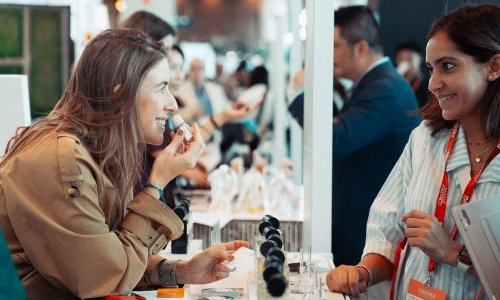
Environmental information of consumer products, one of the consequences of this new policy, was one of the issues to be debated at the last breakfast organized, on December 17th in Paris, by the BeautyFULL Club, an association of professionals in the beauty industry. Hervé Rebollo, Director of Economic and International Affairs at the French Federation of Beauty Companies (Fédération des entreprises de la beauté, FEBEA), has reviewed for us the situation concerning the different projects and how they could affect the cosmetics industry.
"This request is a ground swell initiated by the public opinion, explains Hervé Rebollo, it is relayed by politicians, eco friendly personalities, NGOs, consumer associations, and by professionals." For him, no doubt about it, "you may have your own opinion about this request but it’s impossible to go against it." Especially now that it is backed up by a law.
Statutory Requirements
The law called "Grenelle 1", passed in the wake of discussions held at the "Grenelle Environnement" stipulates that: "Consumers must have access to sincere, objective and comprehensive environmental information, on the global characteristics of the pair product / packaging ( ...). Information about environmental impacts of products (...) will be progressively developed." [1]
There is a second law, known as "Grenelle 2," a law which is still under consideration by Parliament, which sets the deadline, stating that consumer information should begin gradually – this point is important, it is not a big bang that is expected, but a gradual onset – as of January 1st, 2011. The goal is very ambitious given the practical difficulties and the financial magnitude of the project.
Life cycle assessment
It is also the Grenelle 2 bill which specifies the nature of this environmental labeling. It should refer to "the equivalent carbon content of products and their packaging, as well as the consumption of natural resources or the impact on natural environments which are attributable to these products during their lifecycle".
The method of Life Cycle Assessment (LCA), as defined by ISO [2], is at the heart of the project. For practical purposes, the ADEME [3] and the AFNOR [4] were entrusted the task of proposing a method to achieve this information display.
A referencing system of best practices [5] was published in October, but it is only a general method, which must be amended with proposals from sectorial workgroups. "And we are monitoring this issue closely since we are in charge of the secretarial work of the workgroup 4B, dedicated to cosmetic products and beauty industry," underlines Hervé Rebollo.
Of course, all this has a cost. To achieve an LCA is not easy and companies will have to mobilize important human and financial resources. The difficulty is also more important for SMEs, which have fewer resources than large groups, which will have to process thousands of references. "And this does not only concern manufacturers of finished products," warns Hervé Rebollo. "Suppliers will have to participate by providing their clients with the information they need." And apparently, no subsidy is to be hoped for.
The test on shampoos
The workgroup for cosmetics chose to test the method on shampoos. According to Hervé Rebollo, "this is actually the best selling item, all networks considered after shower gels". This guarantees a good visibility of the new information when it is achieved. And shampoos are also the items "for which there is the most available data, and also they are rinsed products and the issue concerning the impact of our products on aquatic environments is to be considered".
Work is underway, data has been collected from industrials "and we should very quickly see the outcome". Note that the use phase is to be taken into consideration: for instance, the energy needed to heat the water during a shampoo has a signficant impact on the results. However, for the time being, the comings and goings of consumers to the stores have not been taken into account in the method used for analysis.
Many issues need to be clarified, including the practical details concerning the information to consumers: labelling or posting on the point of sale, or both of them? The question of the inclusion of this French requirement in the European context is also unsolved. For companies in any case, "the subject should be at the heart of concerns for the 10 or 15 years to come."